Confidence in Sports: How Teen Athletes Actually Build It

Why Confidence Looks Inconsistent in Teen Athletes
Many parents notice something puzzling about confidence in sports.
One day, their teen looks focused, decisive, and capable. Their movements are fluid, their communication is clear, and they appear fully present in the moment. Then, seemingly overnight, something shifts. The same athlete begins to hesitate, overthink routine plays, or second-guess decisions they normally make with ease.
This inconsistency can be confusing, especially for parents who know their child is capable.
It is common to hear questions such as why an athlete performs comfortably in practice but tightens during games, why one mistake seems to unravel their composure, or why confidence disappears precisely when the stakes feel highest.
The explanation is often simpler and more reassuring than many expect.
Confidence is not a fixed personality trait. It is a developmental skill that strengthens through experience.
Just like endurance or strength, it becomes more reliable with repetition and intentional challenge.
Confidence Is Built, Not Declared
Teen athletes do not develop lasting confidence from praise alone or from being told to “believe in yourself.” Encouragement matters, but belief becomes durable only when it is supported by evidence.
Athletes trust what they have lived through.
When teens prepare thoroughly, repeat skills across varying conditions, follow through on commitments, and learn how to recover after mistakes, they begin building an internal record of capability. Instead of hoping they can handle pressure, they remember that they already have.
Sport psychology research consistently identifies mastery experiences as one of the strongest predictors of confidence because they transform effort into proof. Parents interested in the science behind this process can explore resources from the Positive Coaching Alliance’s Positive Sports Parent/Caregiver guide.
Over time, confidence shifts from emotional to procedural. It becomes less about how an athlete feels in a moment and more about what they know they can do.

The Role of Identity in Athletic Confidence
Confidence deepens when athletes understand who they are beyond a single performance.
Teens who anchor their identity entirely to outcomes often experience emotional volatility. A strong performance can temporarily elevate self-belief, while a mistake or loss may trigger disproportionate self-doubt.
When identity is grounded in effort, discipline, and growth, resilience expands. The internal dialogue begins to mature. Instead of asking, “Am I good enough?” athletes start asking a more stabilizing question: “What is my next best move?”
Adolescence is a critical window for identity development, and supportive environments play a meaningful role in shaping it. The American Academy of Pediatrics explains that experiences helping young people recognize their abilities and strengths are foundational to building confidence and a healthy sense of self, as outlined in guidance on building resilience in children.
Sports can offer exactly this kind of environment when the focus extends beyond performance to include personal development.
Confidence Grows Through Trust, Much Like Training a Dog
At The BOLO Project, the relationship between teens and dogs illustrates how confidence develops.
A dog becomes more assured when expectations are clear and training is consistent. After a misstep, the dog does not interpret the moment as failure. It recalibrates and tries again.
The learning is experiential before it is intellectual.
Teen athletes build confidence in much the same way. When they trust their preparation and learn to respond calmly rather than emotionally when something does not go perfectly, the nervous system begins to interpret pressure differently. Situations that once triggered anxiety gradually feel more manageable.
Studies on human-animal interaction consistently show that spending time with animals can reduce stress and enhance emotional awareness, both of which contribute to better performance and focus. Parents and coaches can learn more from research on human-animal interaction by HABRI.
Confidence, in this sense, is less about intensity and more about regulation.
What Grounded Confidence Looks Like During Competition
Confident athletes are not always the loudest players or the most visibly energized. More often, their steadiness is what distinguishes them.
You might notice that these athletes:
Stay mentally engaged after mistakes rather than withdrawing
Make decisions with less visible hesitation
Communicate clearly with teammates
Maintain competitive intensity without panic
Reset more quickly when momentum shifts
Their confidence is not performative. It is functional, accessible even when conditions are imperfect.
What Parents Can Do to Support Real Confidence
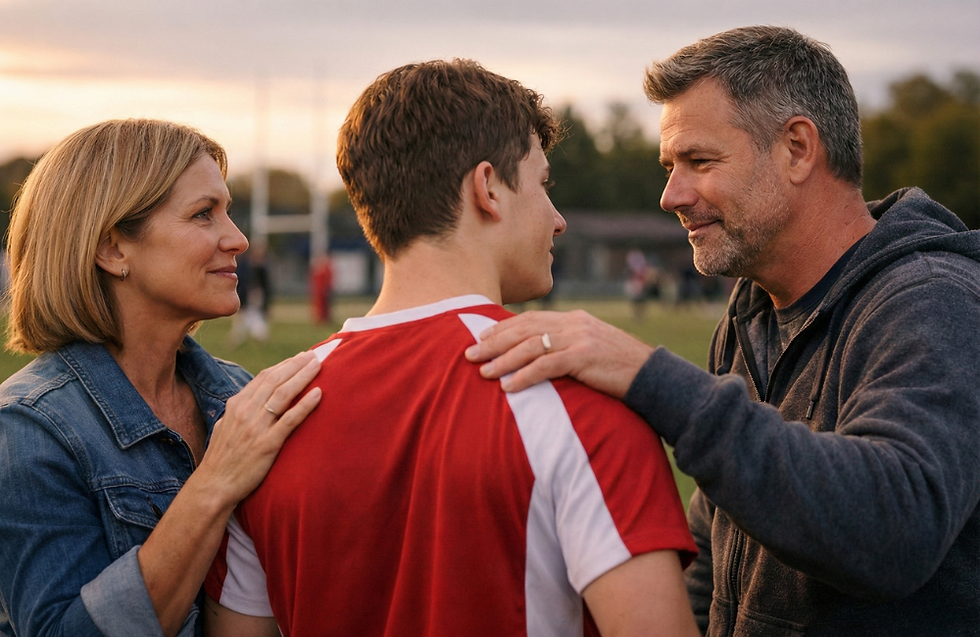
Parents shape the emotional climate surrounding youth sports more than they sometimes realize. Subtle reactions after games, sideline body language, and post-performance conversations all influence how teens interpret success and failure.
Supportive parenting does not mean removing challenge. Instead, it means creating psychological safety around growth.
Parents often help most when they emphasize behaviors within the athlete’s control and resist the urge to immediately analyze performance. This approach allows teens to process their experience rather than defend it.
Consider reinforcing development by:
Highlighting preparation and consistency rather than statistics
Asking reflective questions about what felt strong or what was learned
Modeling emotional steadiness after both wins and losses
Allowing space before offering feedback
When teens feel supported in learning rather than judged solely on outcomes, they become more willing to stretch beyond their comfort zone. That willingness is where confidence expands.
Why Athletic Confidence Transfers Far Beyond Sports
One of the most enduring gifts athletics can offer is not found on a scoreboard. It is the quiet realization: “I can handle pressure.”
A teen who learns how to regulate emotion before a decisive play is rehearsing the same psychological skill they will later use during an exam, a leadership moment, a difficult conversation, or a professional challenge.
Confidence developed in sport often carries into areas such as:
Academic persistence
Leadership readiness
Social courage
Decision-making under uncertainty
Career adaptability
Neuroscience continues to affirm that repeated exposure to manageable stress strengthens the brain’s capacity for adaptive response. Practiced challenge builds resilience.
Sports simply provide a structured arena where that rehearsal happens naturally.

A Perspective for Parents Navigating the Athletic Years
At The BOLO Project, we remind families that confidence is not something teens either possess or lack. It is something they train.
When young athletes learn to anchor confidence in preparation, identity, and response, sports become more than competition. They become a laboratory for self-leadership.
Through this process, teens begin to trust themselves. They discover that mistakes are survivable, adjustment is possible, and growth is ongoing.
Programs grounded in neuroscience, leadership development, and experiential learning, especially those incorporating the regulating presence of dogs, can accelerate this growth by helping teens practice calm focus, emotional awareness, and intentional action in real time.
The outcome is not simply a stronger athlete, but a more resilient young person prepared to meet life with steadiness long after the final whistle.
If you would like to explore programs designed to help athletes build confidence, emotional control, and a championship mindset, we invite you to learn more about The BOLO Project’s workshops and resources.


